History of Murchison Falls National Park: From Ancient Landscapes to Uganda’s Greatest Safari Destination
Introduction
The history of Murchison Falls National Park is deeply connected to the history of Uganda, the River Nile, wildlife conservation, local communities, colonial exploration and the development of safari tourism in East Africa. Today, Murchison Falls National Park is recognized as one of Uganda’s most important wildlife destinations and is the country’s largest national park, covering approximately 3,840 square kilometers. However, the protected area that visitors experience today developed through many different stages over more than a century.
The story begins long before the area became a national park. The landscape around Murchison Falls has been home to local communities, wildlife and natural ecosystems for generations. The River Nile was an important geographical feature long before European explorers arrived, while the waterfall itself had cultural significance among communities living around the area.
European exploration during the 19th century brought a new chapter to the history of the region. Later, outbreaks of sleeping sickness dramatically changed settlement patterns and contributed to the establishment of some of the earliest wildlife reserves in the area. These reserves eventually developed into what became Murchison Falls National Park.
The history of the park also includes a period when it became one of East Africa’s most famous safari destinations, followed by difficult decades of political instability, poaching and wildlife decline. In more recent years, conservation efforts have helped restore many wildlife populations and strengthen the park’s importance as a tourism and conservation destination.
Understanding this history makes a visit to Murchison Falls more meaningful because the park is not simply a place where tourists go to see animals. It is a landscape shaped by people, wildlife, conservation and a changing relationship between Uganda and its natural heritage.
The Land Before the National Park
Long before Murchison Falls National Park was created, the area was inhabited and used by local communities. The region surrounding the present-day park historically included areas associated with the Banyoro, Acholi and Alur peoples.
The River Nile provided water and supported human activities, while the surrounding grasslands, woodlands and forests provided natural resources. The landscape was therefore not an empty wilderness waiting to be discovered. It was a lived-in environment with its own communities, traditions, beliefs and relationships with nature.
The waterfall itself also had significance beyond its physical beauty. Historical accounts describe the falls as having an indigenous name associated with local beliefs and spiritual practices. Some sources identify the earlier name as Pajok, a Luo term associated with a place of spirits.
This cultural history is important because modern tourism sometimes focuses primarily on the colonial name “Murchison Falls,” while the landscape has a much older history connected to the communities that lived around it.
The Arrival of European Explorers
The 19th century brought European explorers into the region as part of the wider European interest in the Nile and the geography of East Africa.
John Hanning Speke and James Grant were among the first European explorers associated with visiting the area of what is now the Murchison Falls Conservation Area in 1862. Their journey was part of the broader European exploration surrounding the search for the source and course of the Nile.
Samuel Baker and his wife Florence Baker explored the area more thoroughly in 1863 and 1864. Samuel Baker was particularly impressed by the waterfall and the powerful Nile passing through the narrow gorge.
It was during this period that the waterfall became known internationally as Murchison Falls. Samuel Baker named it after Sir Roderick Murchison, a Scottish geologist and then president of the Royal Geographical Society.
The name Murchison Falls eventually became firmly established in maps, travel literature and later tourism.
The Meaning Behind the Name Murchison Falls
The name Murchison Falls is therefore connected to the history of European exploration rather than being the original indigenous name of the waterfall.
Sir Roderick Murchison was an influential geologist and geographical figure in 19th-century Britain. Naming geographical features after prominent European figures was common during the period of European exploration and colonial expansion.
Today, the name Murchison Falls is internationally recognized and is closely associated with Uganda’s safari industry.
However, understanding the older cultural names and traditions connected to the falls provides a more complete picture of its history. The waterfall existed for thousands of years before it was given its modern international name.
Sleeping Sickness and the Transformation of the Region
One of the most important events in the early conservation history of the Murchison Falls region was the outbreak of sleeping sickness.
Between approximately 1907 and 1912, sleeping sickness spread through parts of the region. The disease was transmitted by tsetse flies and had a devastating impact on communities.
Colonial authorities responded by evacuating people from a very large area. Historical sources describe approximately 13,000 square kilometers being affected by population evacuation during this period.
This massive disruption dramatically changed the relationship between people and the landscape.
Areas that had previously supported human settlement became much less populated. The reduction in human activity also reduced hunting pressure in some areas, allowing wildlife populations to increase.
The consequences of this period eventually contributed to the development of formal wildlife conservation areas.
The Creation of the Bunyoro Game Reserve
In 1910, the Bunyoro Game Reserve was established south of the River Nile. The area covered parts of what are now associated with the Murchison Falls region, including areas within present-day Masindi, Buliisa and Kiryandongo.
The creation of the reserve marked an important stage in the formal history of wildlife conservation in the region.
Wildlife had benefited from reduced hunting pressure following the depopulation caused by sleeping sickness. The establishment of a reserve provided an additional legal framework for protecting wildlife.
However, conservation during the colonial period was not always based on the same principles of community participation and shared benefits that are emphasized in modern conservation.
The creation of protected areas could restrict local access to land and natural resources, creating tensions between conservation authorities and communities.
Expansion of the Protected Area
The protected area continued to expand during the 1920s.
In 1926, the Bunyoro and Gulu Wildlife Reserve was formally gazetted over an area that is now part of the Murchison Falls Conservation Area. Uganda Wildlife Authority describes the area as one of Uganda’s oldest protected areas.
In 1928, the boundaries were extended north of the River Nile into what is now Nwoya District, and the protected area became associated with the Bunyoro-Gulu Game Reserve.
This expansion was important because it brought a much larger area of savannah and wildlife habitat under formal protection.
The reserve’s growing wildlife population would later help establish the foundation for Murchison Falls National Park.
The Development of Budongo Forest Reserve
Another important part of the conservation history surrounding Murchison Falls is Budongo Forest.
Budongo Forest Reserve was established in 1932 and became an important forest resource during the colonial period. Historical sources describe it as one of Uganda’s early commercial logging concessions.
Although forestry and wildlife conservation were different activities, the history of Budongo is closely connected to the wider Murchison Falls landscape.
Today, Budongo is particularly important for forest biodiversity and primate experiences. Visitors can explore the forest for chimpanzee experiences, birdwatching and nature activities.
The relationship between Murchison Falls, Budongo Forest and the surrounding reserves demonstrates that conservation in this region developed through several different protected-area systems rather than through the national park alone.
Murchison Falls Becomes a National Park
One of the most important dates in the history of Murchison Falls is 1952.
Uganda passed the National Parks Act in 1952, providing a legal framework for the creation of national parks. Murchison Falls National Park was subsequently established under this new framework, building on the earlier Bunyoro and Gulu protected areas.
This transformed the area from a game reserve into a national park and marked the beginning of a new chapter in Uganda’s formal conservation history.
Murchison Falls became one of Uganda’s first national parks, alongside Queen Elizabeth National Park.
The new national park status gave the government a stronger legal framework for protecting wildlife, vegetation and the spectacular landscapes around the Nile.
The Golden Age of Murchison Falls Safari Tourism
During the 1950s and 1960s, Murchison Falls developed into one of the most important safari destinations in East Africa.
Wildlife populations had benefited from decades of reduced hunting pressure, and the park offered visitors spectacular scenery combined with abundant wildlife.
The River Nile and Murchison Falls became major attractions, while elephants, buffaloes, hippos, crocodiles and other wildlife contributed to the park’s growing reputation.
By the mid-1960s, Murchison Falls had become one of the leading safari destinations in East Africa. Historical sources report that the park was receiving more than 60,000 visitors annually during this period.
This period can be described as a golden age for the park’s tourism industry.
Visitors came to experience the Nile, observe large herds of wildlife and explore the savannah by vehicle. The development of tourism infrastructure also helped establish Murchison Falls as a major destination on the East African safari circuit.
The Creation of Surrounding Wildlife Reserves
As the importance of Murchison Falls grew, conservation authorities recognized the need to protect habitats surrounding the national park.
In 1963, the Karuma and Bugungu areas were established as controlled hunting areas. They were later upgraded to game reserves, with Karuma receiving game reserve status in 1964 and Bugungu in 1968.
These areas helped create a wider conservation landscape around the national park.
Today, Murchison Falls National Park, together with the adjacent Karuma and Bugungu Wildlife Reserves, forms the broader Murchison Falls Conservation Area.
This wider landscape is important because wildlife does not recognize human-drawn boundaries. Animals move between habitats in search of food, water, mates and safe areas.
The Name Kabalega National Park
Another interesting chapter in the history of Murchison Falls concerns the name Kabalega.
The park was at one point referred to as Kabalega National Park, after Omukama Kabalega of the Kingdom of Bunyoro. Kabalega was one of the most important historical figures in the resistance against British colonial expansion in Uganda during the late 19th century.
The use of the name Kabalega reflected an attempt to associate the protected area with an important Ugandan historical figure.
The name did not remain permanent, and Murchison Falls eventually became the established name again. Some historical references also continue to use Kabalega in connection with the falls.
The history of the name demonstrates how national parks can carry political, cultural and historical meanings in addition to their conservation roles.
Murchison Falls During Uganda’s Political Turbulence
The prosperity of Murchison Falls did not continue uninterrupted.
Uganda experienced significant political instability during the 1970s and early 1980s. This had serious consequences for wildlife conservation across the country.
Murchison Falls was particularly affected by poaching and the breakdown of conservation systems. During the late 1970s and 1980s, wildlife populations suffered significant declines. Historical accounts describe elephants and other large mammals being killed for meat, ivory and other purposes, while political instability weakened wildlife protection.
The decline was devastating because the park had previously supported large and important wildlife populations.
Tourism also suffered during this period. International visitors became less willing to travel to Uganda because of insecurity and political instability.
The park entered one of the most difficult periods in its history.
The Impact of Poaching
Poaching had a profound effect on Murchison Falls National Park.
Large mammals such as elephants and buffaloes were particularly vulnerable. The decline of these animals affected not only tourism but also the ecological balance of the park.
The situation demonstrated how strongly wildlife conservation depends on political stability, effective law enforcement and adequate funding.
A national park can have abundant wildlife and beautiful landscapes, but without effective protection, wildlife populations can decline rapidly.
The experience of Murchison Falls during this period remains an important part of Uganda’s conservation history.
Recovery and Modern Conservation
The recovery of Murchison Falls National Park began as Uganda gradually restored political stability and strengthened wildlife conservation institutions.
Conservation authorities, local communities, tourism operators and international partners have contributed to the gradual restoration of wildlife populations.
The Uganda Wildlife Authority now manages Murchison Falls National Park as part of Uganda’s national protected-area system.
Modern conservation focuses not only on protecting animals from poaching but also on habitat management, tourism development, community engagement and sustainable use of natural resources.
The park’s recovery demonstrates the possibility of restoring wildlife landscapes after periods of severe decline.
Murchison Falls National Park Today
Today, Murchison Falls National Park is one of Uganda’s most important safari destinations.
The park covers approximately 3,840 square kilometers and contains extensive savannah, woodland and riverine habitats. Uganda Wildlife Authority describes it as Uganda’s oldest and largest conservation area.
The park is famous for its elephants, giraffes, buffaloes, Uganda kobs, lions and other wildlife. Visitors can also encounter hippos and crocodiles along the Nile.
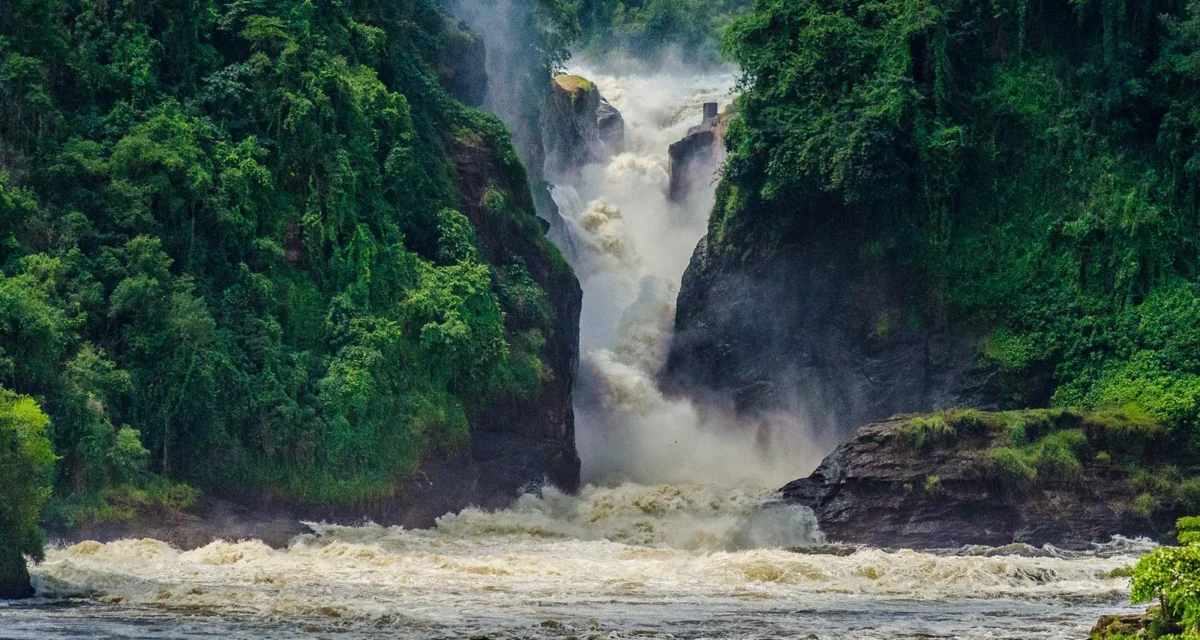
The waterfall itself remains the defining attraction. At Murchison Falls, the Nile is forced through a narrow gorge before plunging dramatically downstream.
The combination of waterfall, river and wildlife makes the destination unique within Uganda’s tourism industry.
The History of Safari Activities in Murchison Falls
Safari activities have changed considerably since the early days of the park.
Early visitors were primarily interested in wildlife viewing, hunting and exploration. Modern visitors arrive for very different reasons.
Today, game drives are one of the park’s major attractions. Visitors explore the savannah in search of elephants, giraffes, buffaloes, lions, antelopes and other animals.
Boat cruises along the Victoria Nile have also become an important part of the safari experience. From the water, visitors can observe hippos, crocodiles, elephants and birds while traveling toward the bottom of Murchison Falls.
Visitors can also explore the Top of the Falls, participate in birdwatching and combine the park with experiences in Budongo Forest and other surrounding destinations.
The development of these activities reflects the transformation of Murchison Falls from a hunting and exploration landscape into a modern conservation and tourism destination.
Murchison Falls and Local Communities
The history of Murchison Falls cannot be fully understood without considering the people who live around the protected area.
The establishment and expansion of protected areas historically affected local communities through restrictions on land use, hunting, cultivation, grazing and access to natural resources.
Some communities experienced displacement or restrictions as conservation boundaries expanded. Historical records show that the development of surrounding protected areas sometimes created tension because people lost access to land and were uncertain about changing boundaries.
Modern conservation has increasingly recognized the importance of local communities.
Tourism can provide employment, business opportunities and income for communities around protected areas. Community-based conservation and tourism initiatives can also help create stronger relationships between local people and wildlife conservation.
The future of Murchison Falls therefore depends not only on protecting animals inside the park but also on maintaining positive relationships with the communities surrounding it.
The Importance of the Nile in the History of the Park
The Nile has been central to the history of Murchison Falls from the beginning.
It shaped the landscape, supported communities, attracted explorers and became one of the park’s greatest tourism attractions.
The river also explains why Murchison Falls became such an important safari destination. Visitors can experience wildlife along its banks, observe hippos and crocodiles in the water and travel by boat toward the waterfall.
The Nile connects Murchison Falls with Lake Victoria, Lake Albert and the wider Nile system, making the park part of one of Africa’s most important river networks.
Without the Nile, the history and identity of Murchison Falls would be completely different.
Murchison Falls as a Conservation Success Story
The history of Murchison Falls contains difficult chapters, but it also demonstrates the resilience of nature.
The area experienced disease outbreaks, population displacement, colonial conservation policies, rapid tourism growth, political instability, poaching and wildlife decline.
Yet the park has survived these challenges.
Wildlife populations have recovered from some of their historical lows, tourism has returned and conservation has become a central part of Uganda’s national development strategy.
The park now attracts travelers from around the world who come to experience Uganda’s wildlife and landscapes.
Its history demonstrates that conservation is a long-term process. Protecting a national park requires continuous investment, enforcement, community involvement, research and responsible tourism.
Why Understanding the History Matters to Visitors
Knowing the history of Murchison Falls changes the way visitors experience the park.
When travelers stand at the Top of Murchison Falls and watch the Nile rushing through the gorge, they are looking at a landscape with a history that stretches far beyond modern tourism.
When they see elephants crossing the savannah, they are witnessing wildlife populations that have survived dramatic changes in Uganda’s conservation history.
When they visit Budongo Forest, they are entering another important part of the region’s environmental history.
The park therefore becomes more than a safari destination. It becomes a place where geography, culture, wildlife, conservation and history come together.
Conclusion
The history of Murchison Falls National Park is a remarkable story of exploration, conservation, wildlife, communities and resilience.
The area existed for thousands of years before it became a protected area, with local communities living around the Nile and developing their own cultural relationships with the landscape. European explorers arrived in the 1860s, and Samuel Baker later gave the waterfall the name Murchison Falls.
The early 20th century brought dramatic changes when sleeping sickness affected the region and large areas were evacuated. The reduction in human activity and hunting helped create conditions for formal wildlife conservation. The Bunyoro Game Reserve was established in 1910, followed by further expansion and the development of the Bunyoro-Gulu protected area.
The National Parks Act of 1952 marked another major turning point when Murchison Falls became a national park. During the 1950s and 1960s, the park developed into one of East Africa’s leading safari destinations.
The following decades brought political instability and severe wildlife losses caused by poaching and weakened conservation systems. However, subsequent conservation efforts have helped the park recover and regain its importance.
Today, Murchison Falls National Park stands as one of Uganda’s most important wildlife destinations. Its elephants, giraffes, buffaloes, lions, hippos, crocodiles, birds and other wildlife share a landscape dominated by the Victoria Nile and the spectacular Murchison Falls.
The history of Murchison Falls is therefore not simply a story about how a national park was created. It is a story about how people, wildlife, rivers, forests and changing conservation ideas have shaped one of Uganda’s most extraordinary landscapes.
For anyone planning to visit Murchison Falls National Park, understanding this history adds depth to the safari. Every game drive, boat cruise and visit to the waterfall becomes part of a much larger story — a story that continues to evolve as Uganda works to protect its natural heritage for future generations.